Toileting
How to start potty training without a rigid weekend plan
Updated
You do not need a cleared weekend, a script, or a three-day sprint to begin. Starting potty training is mostly noticing what your child can already do, making the bathroom easy to reach, and offering practice without turning every wet diaper into a test. Some children move quickly. Others take months. Both patterns are common, and neither is a verdict on you or them.
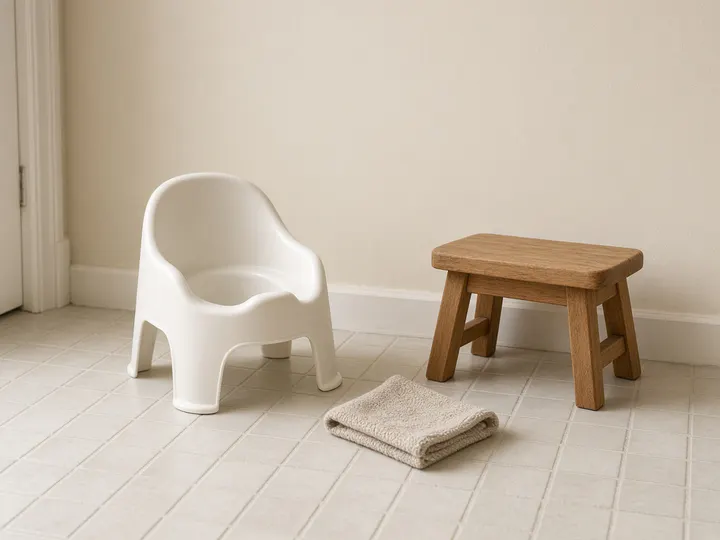
Low-pressure practice in a bathroom set up for easy access.
A concentrated weekend can work for families who already see many readiness cues and can keep the same adults, routines, and bathroom access for several days. It is not required. The American Academy of Pediatrics (AAP) treats toilet learning as a developmental process that follows the child, not a date on the calendar.
Readiness is information, not a pass/fail test
Readiness is a cluster of skills and interests, not a single green light. You are gathering information, not waiting to be allowed to start.
Things that often make practice easier include:
- Staying dry for a stretch, such as during a nap or for about two hours
- Showing awareness of pee or poop—pausing, hiding, telling you, or looking uncomfortable
- Walking to the bathroom and sitting down and getting up, with help as needed
- Pulling pants down and up, even if it is slow or messy
- Following a simple two-step request
- Curiosity about the toilet, underwear, or what other people do in the bathroom
- Bowel movements that are not regularly painful or very hard
None of these has to appear all at once. A child who is interested but still in diapers is not behind. A child who can stay dry but has no interest yet is not failing a test. You can offer the potty because interest is there, or you can wait and keep watching. Either is a reasonable choice.
The AAP notes that many children begin toilet learning somewhere between 18 months and 3 years, and that some are not ready until later. The Centers for Disease Control and Prevention (CDC) lists using the toilet independently among skills most children can do by age 4. That is a population milestone for watching development over time—not a start date, and not a reason to rush or to delay if your child is already practicing.
Stress, a new sibling, travel, illness, or a big schedule change can make this a harder week to begin. That is information too. You can pause and return without erasing what they have already learned.
Set up the bathroom and clothing so practice is easy
You do not need special products. You do need a path your child can use when they notice a cue.
Bathroom. Keep the route clear. If you use a child-sized potty, put it in the bathroom you already use, not in a room they rarely enter. If you use the regular toilet, a stable step and a seat insert can help their feet rest and their body feel secure. Let them flush or skip the flush; some children like the sound, some do not. Keep toilet paper or wipes where they can reach with you nearby. Wash hands together every time so the sequence stays the same: sit, try, wipe as needed, flush if you are using the toilet, wash.
Clothing. Choose pants that come down quickly—elastic waists, no overalls, no snaps at the crotch during practice hours. Bare feet or easy-off shoes help at home. A wet or soiled diaper is slower to remove than loose pants. If you try underwear for part of the day, pick a stretch when you can get to the bathroom fast. Nighttime dryness often comes later than daytime practice; keep overnight diapers or pull-ons if nights are still wet.
A place to sit that is not a demand. Leave the potty visible. Sitting fully clothed at first is fine. Looking at a book on the potty is fine. The goal is familiarity, not a performance.
Skip anything that turns the bathroom into a scoreboard. A brief “you sat on the potty” is enough. Rewards are optional and should never become the reason they are allowed to get up.
Offer and model without pressure
Offer; do not interrogate.
A simple offer sounds like: “The potty is here if you want to try.” Or, at a natural pause: “Let’s stop in the bathroom before we go outside.” Pair offers with times pee or poop often happen—after waking, after meals, before leaving the house—not every few minutes.
Model in ordinary ways. Let them see a trusted adult use the toilet if everyone is comfortable with that. Use plain words for pee, poop, wet, and dry. Narrate briefly: “I’m going to pee, then I’ll wash my hands.” If they sit and nothing happens, say “Thanks for trying” and move on. Do not keep them sitting until they produce something.
If they say no, accept the no. Asking again later is different from hovering. Children who feel they must perform on the potty often hold pee or poop, which can make learning harder and more uncomfortable.
Underwear is a tool, not a promotion. Some families start with underwear during a quiet morning at home. Others keep diapers and sit on the potty at diaper changes. Both are legitimate starts. What matters is that the child can get to a toilet quickly and is not scolded for using the diaper they are wearing.
If more than one caregiver is involved, use the same words and the same no-pressure rule. Mixed messages—one adult waiting calmly, another insisting they sit until they go—undo a calm start faster than a wet floor does.
When accidents happen
Accidents are how toddlers learn where pee and poop belong. They are not misbehavior.
Stay matter-of-fact: “Pee went on the floor. That’s okay. Let’s get towels and dry pants.” Involve them in cleanup only in a light way if they want to help—handing you a towel, putting wet clothes in the hamper—not as punishment. Change into dry clothes and continue the day.
Avoid asking “Why didn’t you tell me?” in a frustrated voice, making them sit on the potty as a consequence, withholding affection or play, or comparing them to a sibling or “kids their age.”
If accidents increase after a calm stretch, look at the week before you look at the child. New childcare, constipation, illness, or a lot of “did you go?” questions can all scatter progress. You can return to diapers for a while without it being a failure. Many children do.
Notice the parts they can control: walking to the bathroom, telling you, sitting, washing hands. Do not save all the warmth for a successful pee. That turns the toilet into a pass/fail again.
When poop is hard or the child is distressed
Painful poop and potty practice do not mix well. If stools are hard, pebble-like, or infrequent, or if your child cries, withholds, or refuses the potty with real distress, pause the push to be out of diapers and talk with your child’s pediatrician. Constipation can make a child avoid the toilet because they expect it to hurt. Holding stool can make constipation worse. That loop needs medical attention, not more drills.
Also check in if you see blood in the stool or urine, pain with peeing, a sudden return of accidents after a long dry period, fever with urinary symptoms, or fear of the bathroom that does not ease with short, calm visits.
Do not start or continue a restrictive weekend method while your child is in pain. Comfort comes first.
Related reading
Check in if
Talk with your child’s pediatrician if:
- Poop is regularly hard, painful, or less frequent than is usual for your child
- Your child withholds stool or urine, or seems afraid or distressed about using the toilet
- There is blood in stool or urine, or peeing looks painful
- Daytime accidents continue in a way that worries you after a long stretch of practice, especially after age 4, or you want guidance on what is typical at night
- You are not sure whether to pause because of a medical or developmental concern
Bring a few days of notes if you can: when they pee and poop, what stools look like, and what you have already tried. You are not asking for a verdict on parenting. You are asking whether the body needs help so learning can be comfortable.
Related ages: 18-24 months, 24-36 months. Pillars: Behavior.
Sources
- American Academy of Pediatrics / HealthyChildren.org. Toilet training is a developmental process with no single correct age. Many children show readiness between 18 months and 3 years; some later. HealthyChildren.org emphasizes looking for readiness signs (including staying dry for about two hours, following simple directions, and interest in the toilet), avoiding punishment, and not forcing a child to sit until they go. Painful or hard stools should be addressed, because constipation interferes with toilet learning.
- Centers for Disease Control and Prevention. CDC developmental surveillance lists using the toilet on their own among skills most children can do by 4 years. That milestone describes what is common by that age in a large population; it is not a start-training deadline and does not require a boot-camp method. CDC materials on young children’s development treat toilet learning as part of ordinary caregiver support, not a timed challenge.