Behavior
Toddler separation anxiety at drop-off and bedtime
Updated
Tears at the classroom door or at lights-out are often a sign that your toddler has learned something important: you leave, and they notice. Separation protest is a common part of toddler development. It can show up at daycare or preschool drop-off, with a babysitter, or at bedtime, when the house gets quiet and you walk out of the room. A short, repeatable goodbye, a warm handoff to the next trusted adult, and the same words from everyone who cares for your child usually help more than a longer farewell. Most toddlers settle after you go. If distress is severe or persistent, skills are lost, or your child cannot settle with trusted adults, talk with your pediatrician.
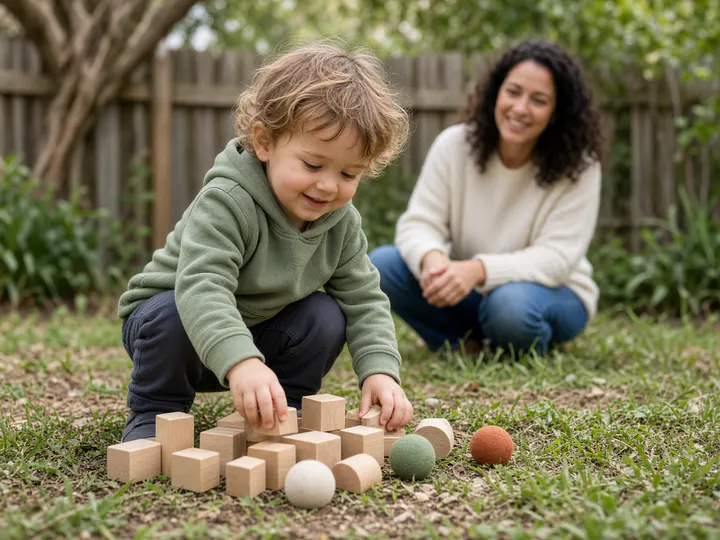
A short, predictable goodbye can help a toddler settle after you leave.
Why drop-off and bedtime feel so hard
Toddlers are building a map of people and places. They know you are the person who feeds, holds, and comes back, but they still have a thin sense of time. “After lunch” and “after your rest” do not yet mean what they mean to you. A classroom doorway or a dark bedroom can feel like a cliff: you are here, then you are not.
The American Academy of Pediatrics (AAP), through HealthyChildren.org, describes separation anxiety as a typical developmental stage that often begins in the first year and can continue or return in the toddler and preschool years. It is not a verdict on your parenting, your child’s “independence,” or the quality of a new caregiver. It can flare with a new classroom, a schedule change, travel, illness, a new sibling, or a stretch of disrupted sleep. The same child who waved yesterday may cling today.
The Centers for Disease Control and Prevention (CDC) lists crying when a parent leaves among expected social and emotional patterns around the first birthday. That does not mean every goodbye will be tearful, or that tears at age two are a problem on their own. It does mean protest at parting is a known part of how many young children show attachment, not a failure to “get used to it.”
Drop-off and bedtime share a structure: you are the last familiar face, then you go. What helps in both places is the same: a goodbye the child can predict, a next person or next step that feels safe, and a reunion that actually happens.
Use a predictable goodbye script
Sneaking out can make the next goodbye harder. The AAP advises saying goodbye rather than slipping away, then leaving without a long linger at the door. A script gives your toddler something to hold onto when the feeling is big.
Keep it short enough that you can say it the same way on a rushed morning and a slow evening. Name the leaving, the next person or next step, and the return in words your child already knows.
A drop-off script you can reuse
- Get to the same spot each time: cubby, classroom door, or the place the teacher prefers.
- One hug or hand-hold. Do not restart the hug after you have already let go.
- Say the same three beats: love, who is in charge now, when you come back. Example: “I love you. Ms. Jordan is here. I will be back after snack.”
- Hand off and walk out. Waving from the sidewalk is optional; turning around for a second goodbye is not.
A bedtime script you can reuse
- Finish the same wind-down you already use: wash, pajamas, book, lights.
- Put your child in the sleep space while you are still calm and present.
- Say the same three beats: love, what happens next, that you are nearby. Example: “I love you. I will check on you after I do the dishes. You are safe. Good night.”
- Leave the room. If you return for a check, keep it boring and brief so the check does not become a new party.
If your child cries, the script still stands. Repeating a new speech from the doorway teaches them that more words might keep you. The ritual is the comfort, not a longer explanation.
Keep the handoff short and warm
A warm handoff is not a cold drop. It is a transfer of safety from you to the next adult, fast enough that your child does not have time to bargain for a second ending.
At care, let the teacher take the lead once you have said the script. Place your child in their arms or next to an activity the room already uses for arrivals: a puzzle table, a water cup, a familiar mat. Then go. Many children cry hardest in the last ten seconds with a parent and settle with a known caregiver after the door closes. Ask the teacher, later, how long it took to settle. That information is more useful than the sound in the hallway.
At bedtime, the “handoff” is to the room, a night-light if you use one, and the routine itself. Do not add a new toy, video, or snack as a ticket out of the room. A familiar cloth or stuffed animal already in the crib or bed can travel with your child if your family uses a comfort object; the AAP notes that these transitional objects can help some children. You do not need to buy anything new for this to work.
If a partner, grandparent, or sitter is the one leaving or staying, they use the same short shape: one connection, the script, the exit. Trading a long, guilty goodbye for a warm, finite one is not withholding. It is how you show that leaving is survivable.
Match the words every caregiver uses
Toddlers track language more than we think. If you say “back after snack,” the teacher says “Mommy will come later,” and a grandparent says “Don’t cry, be a big kid,” the child hears three different stories and no clear landing.
Agree on a few shared phrases and write them down for anyone who does drop-off or bedtime:
- The return cue: “after snack,” “after rest,” or “after work,” whichever is true and simple.
- The safety cue: “You are safe. Ms. Jordan is here.” or “Dad is in the kitchen.”
- What you will not say: “Don’t cry,” “Nothing to be afraid of,” or “If you stop, I will stay.” Those lines ask a toddler to manage your leaving for you.
Teachers and sitters can narrate the same return cue while they help your child into the day: “Dad comes after snack. We are putting your bag here.” At night, whoever is on bedtime duty uses the same check-in line you use. Matching words is not a script for the child’s feelings. It is a shared map so the feeling has a place to go.
Practice in small doses, then reconnect for real
You do not need to rehearse every hard goodbye, but small, planned separations during the day teach the full cycle: leave, stay gone, come back.
Try brief practices that you can finish:
- Play in the next room with the door open, then with the door cracked, using the same “I will be back” line.
- A short stay with a known adult while you walk to the mailbox or sit in the car for a few minutes, then return when you said you would.
- Peekaboo, hide-and-find, and “I’ll be right here” games that make disappearance and return ordinary.
Keep practices shorter than your child’s current stretch. Coming back early is better than stretching until panic is the lesson.
Reconnection is the other half of the work. When you pick up from care, get low, use their name, and give a quiet minute before you ask about the day. At night, morning is the reunion: curtains, a consistent greeting, the same parent energy you had at goodbye. A toddler learns that goodbye is a comma when hello keeps arriving on time. If pickup or morning is rushed and cold, the next drop-off has to carry more fear.
Protect sleep and hunger around hard goodbyes when you can. A toddler who is tired or hungry has less room for a big feeling. That is logistics, not a character test.
Related reading
Check in if
Talk with your pediatrician if goodbye distress is severe or lasts in a way that does not ease across weeks of a consistent routine; if your toddler loses language, motor, or social skills they already had; or if they cannot settle with a familiar teacher, sitter, or other trusted adult after you leave. The CDC advises acting early when a child loses skills they once had, and your pediatrician can help sort typical protest from a need for more support. Call sooner if you are worried, if drop-off or bedtime is unsafe, or if your own stress is making it hard to leave in a calm, predictable way. You do not have to wait for a crisis to ask.
Related ages: 12-18 months, 18-24 months, 24-36 months. Pillars: Behavior.
Sources
- American Academy of Pediatrics. How to Ease Your Child’s Separation Anxiety. HealthyChildren.org. The AAP describes separation anxiety as a typical developmental stage and recommends a consistent, brief goodbye rather than sneaking away.
- American Academy of Pediatrics. Transitional Objects. HealthyChildren.org. Notes that a familiar comfort object can help some young children manage time apart from a parent.
- Centers for Disease Control and Prevention. Important Milestones: Your Child By One Year. Learn the Signs. Act Early. Lists crying when a parent leaves among common social and emotional patterns around 12 months.
- Centers for Disease Control and Prevention. If You’re Concerned. Learn the Signs. Act Early. Advises talking with a professional if a child loses skills they once had.