Safety
When can a toddler face forward in the car?
Updated
A birthday is not the switch. Your toddler can face forward only after they have outgrown the rear-facing height or weight limit of their car seat, and only if that change also meets the seat’s instructions and the law where you live. Until then, rear-facing is the safer direction, even if a child looks folded, restless, or “too big” for the seat from the front.
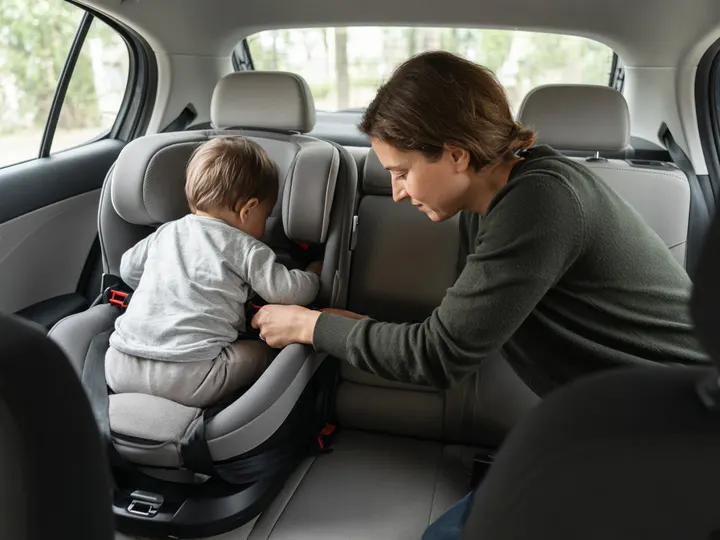
Rear-facing remains the safer direction until the seat’s own height or weight limit is reached.
Many families feel pressure to turn the seat around once walking, talking, or a second birthday arrives. Those milestones matter for play and sleep. They do not set the direction of travel. Crash forces, seat limits, harness path, and local rules do.
The short answer
Keep your toddler rear-facing until they reach the highest rear-facing height or weight allowed by the car-seat manufacturer. Then, if the seat is designed for it, they can ride forward-facing with a harness—still in the back seat—until they outgrow those limits.
That sequence comes from the National Highway Traffic Safety Administration (NHTSA) and the American Academy of Pediatrics (AAP). Both put the seat’s labeled limits ahead of a target age. Safe Kids Worldwide gives the same order: rear-facing as long as the seat allows, then a forward-facing harness, then a booster only after the harness is outgrown.
Two extra filters sit on top of that guidance:
- The instruction manuals. The car-seat manual and the vehicle owner’s manual control installation, recline, tether use, LATCH versus seat belt, and which seating positions are allowed.
- Local law. Some places set a minimum age, weight, or height before a child may ride forward-facing. The legal floor is not the same as the safest practice. If the law allows a turn but the seat still has rear-facing room, staying rear-facing is the better choice.
If those sources disagree, follow the stricter combination: stay rear-facing until the seat’s rear-facing limit, and never use a setup the manuals or the law forbid.
Why rear-facing stays safer longer
In a sudden stop or crash, a rear-facing seat supports the head, neck, and spine together. A toddler’s head is still large relative to their body, and the bones and ligaments of the neck are still developing. Facing the rear spreads crash forces across the back of the seat instead of letting the head snap forward against the harness.
That is why “they look cramped” is not, by itself, a reason to turn. Knees bent, feet touching the vehicle seat, and a child who prefers to look out the window are common in later rear-facing. What matters is whether the head is still within the shell, the harness still fits, and height and weight are still inside the rear-facing range printed on the labels.
Forward-facing with a five-point harness is the next step, not a skip-ahead. It is appropriate after rear-facing limits are reached. It is not a comfort upgrade to use early.
What actually controls the timing
1. The car-seat labels and manual
Find the rear-facing maximum weight and maximum height on the seat and in the booklet. Convertible seats often allow rear-facing well past the first and even the second birthday; some go higher still. Limits vary by model. Guessing from a friend’s seat, a store display, or a photo is not enough.
Also check:
- Whether the seat is rear-facing only, convertible, or another type, and which modes your child’s size may use
- Head-position rules (for example, the top of the head must stay a stated distance below the top of the shell)
- Harness-slot rules for rear-facing versus forward-facing
- When to change recline angle, and how the recline is measured in the vehicle
- Whether the seat must be replaced after a crash, an expiration date, or a recall
If the child has reached a rear-facing limit, the manual—not a calendar—tells you whether this same seat can be used forward-facing or whether you need a different seat that still fits.
2. The law where you drive
Rules differ by state, province, and country. Some require rear-facing until age 2. Others use weight, height, or a combination. Crossing a border, flying and renting a car, or splitting time between two homes can change which rule applies on a given trip.
Look up the current child-passenger law for every place you regularly drive. Use it as a minimum. It does not replace the seat’s rear-facing limit or the vehicle manual.
3. Harness fit, not “they seem ready”
A child is not ready to face forward because they protest the seat, because a sibling faces forward, or because the harness looks easier to buckle from the front. Readiness is a fit-and-limit question:
- Rear-facing harness: straps at or below the shoulders, unless the manual says otherwise
- Forward-facing harness: straps at or above the shoulders, unless the manual says otherwise
- Chest clip: at armpit level
- Snugness: you should not be able to pinch slack in the strap at the shoulder
- Child position: bottom and back against the seat; no bulky coats under the harness
- Head: still supported inside the shell while rear-facing
If the harness cannot be made snug, if the child has outgrown the height or weight range for that mode, or if the head is no longer within the manufacturer’s rear-facing window, it is time to read the next-mode instructions—not to improvise.
4. Installation in this vehicle
A correctly chosen direction still fails if the seat moves too much, sits at the wrong recline, or uses the wrong belt path. Installation checks include:
- Using the belt path that matches the direction of travel
- Locking the vehicle seat belt or using LATCH as the manuals allow—not both unless the manuals say you may
- Keeping the seat from moving more than an inch side-to-side or front-to-back at the belt path
- Using the top tether for forward-facing when the seat and vehicle require or allow it
- Never placing a rear-facing seat in front of an active frontal airbag
- Preferring the back seat for every child using a car seat
Vehicle seats, buckle stalks, and LATCH anchors are not identical. A setup that was solid in one car can be wrong in another.
Practical steps before you turn the seat
- Weigh and measure your child. Use a recent weight and standing height, then compare both with the rear-facing limits on the label.
- Read both manuals in the same sitting. Car-seat booklet and vehicle owner’s manual. Mark the pages for rear-facing limits, forward-facing harness slots, tether, and allowed seating positions.
- Check the law for this trip. Confirm the minimum rear-facing rule where you will drive, including any upcoming travel.
- Inspect the current rear-facing fit. Harness height, chest-clip position, snug straps, head position in the shell, recline indicator.
- Stay rear-facing if any rear-facing capacity remains. Bent knees are expected. Outgrowing the labeled height or weight—or a head-position rule in the manual—is the trigger.
- If limits are reached, change mode by the book. Move the harness to the forward-facing slots, use the forward-facing belt path, attach the tether if required or allowed, and reset recline as instructed.
- Do a hands-on check. After any change of direction, vehicle, or seat, have a certified child passenger safety technician review the installation and the harness.
- Recheck after growth spurts. Direction is not a one-time decision. Height, weight, and harness slot can change the correct setup months later.
Do not add aftermarket straps, mirrors that the manufacturer forbids, thick padding under the child, or winter coats under the harness. Do not place a forward-facing seat in front of an active airbag. Do not assume a used seat is complete, unexpired, and recall-free without checking.
Common sticking points
“They hate sitting backward.” Fussiness is real and exhausting. It is not a crash-test result. Short trips, a calm buckling routine, and checking that the recline and harness are comfortable within the rules help more than turning early.
“Their legs look squished.” Folded legs are typical in later rear-facing. Children often sit cross-legged or rest their feet on the vehicle seat. That position is not, by itself, a harm signal.
“The law says we can turn.” Permission is not a recommendation. NHTSA and the AAP still ask families to use the full rear-facing range of the seat.
“We already turned them.” If the child still fits rear-facing limits and the seat can be reinstalled that way, turning back is allowed and is the safer direction. If they have outgrown rear-facing, keep them forward-facing with a snug harness rather than rushing to a booster.
“Grandparents’ car is different.” Each vehicle needs its own install. Bring the manuals, and repeat the technician check if the seat moves between cars.
A stroller is a separate purchase from the car seat. Prices, weights, and car seat fit for five 2026 models are on the best strollers in 2026 shortlist.
Related reading
Check in if
Talk with a certified child passenger safety technician before you change direction, after you buy or inherit a seat, and whenever the seat will live in a different vehicle. A technician can confirm that the mode, belt path, tether, recline, and harness match both manuals.
Mention car-seat direction at well visits with your pediatrician as well—especially after a growth spurt, a move, or a crash. Bring the seat’s height and weight limits if you can. Clinicians can help you think through fit and timing; they do not replace a hands-on install check.
If your child has a medical or physical need that makes positioning hard, ask the pediatrician and a technician together rather than changing direction on your own.
Related ages: 12-18 months, 18-24 months, 24-36 months. Pillars: Behavior.
Sources
- National Highway Traffic Safety Administration. Keep children rear-facing as long as possible, until they reach the top height or weight limit allowed by the car-seat manufacturer; then use a forward-facing seat with a harness until those limits are reached. Follow the car-seat instructions and the vehicle owner’s manual, and never put a rear-facing seat in front of an active airbag. NHTSA car seats and booster seats
- American Academy of Pediatrics. Infants and toddlers should ride rear-facing as long as possible, until they reach the highest weight or height allowed by their car safety seat’s manufacturer; most convertible seats allow rear-facing for two years or more. After that, use a forward-facing harness as long as the seat allows. AAP / HealthyChildren car safety seats
- Safe Kids Worldwide. Rear-facing is the safest way for young children to travel; use the seat according to the manufacturer, check harness height and snugness (chest clip at armpit level; rear-facing straps at or below the shoulders; forward-facing straps at or above), and have a certified Child Passenger Safety Technician inspect the install. Safe Kids car-seat guidance